Thursday, April 16, 2009

6 Headphone Splitter Schematic

6 Headphone Splitter Schematic
Free Schematic 6 Headphone Splitter Schematic

50Hz Crossover Schematic

50Hz Crossover Schematic

Crossover 50Hz

4-Way Intercom


4-Way Intercom

4Way Intercom


Parts List
R1 10k
R2 150k
R3 4k7
R4 47k
R5 2k2
R6 4k7 trimpot
R7 390R
R8 10k
R9 100k
R10 100k
R11 22k
R12-R15 2k2
R16 4k7
R17 4k7
C1 0.22uF
C2 47uF
C3 1uF
C4 2,200uF (power filter cap – not shown, but wired across +12volts & 0v- ground points
Q1-Q5 BC547 n.p.n low gain
Q6 BC 549C high gain with a beta of at least 250+
D1-D7 1N4148 or 1N914 small signal diodes
IC1 NE 556 dual timer chip
IC2 CD 4017B decade counter chip
OC1-OC3 4N25 or 4N28 opto couplers
Tx 1k/8R transformer, with 1k centre tapped
B1-B4 9 volt DC buzzers mounted inside phone handsets

3V Tube Amplifier Schematic


3V Tube Amplifier Schematic


model:mg-si15dt


3V Tube Amplifier Schematic


schematic diagram showing a vacuum tube amplifier

350Hz Crossover Schematic


350Hz Crossover Schematic

350Hz Crossover

350 Hz. Crossover between the MF and HF subsystems

3 Tone Gong

3 Tone Gong Schematic
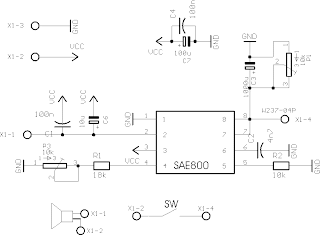

3 Tone Gong


3-tone-gong
This 3-tone-gong is designed to signal different driving directions in different wave forms.
This is done with a SAE800 IC.
There is a 8 pin header that is used to activate a single,
twice or three tone gong melody with active high or active low signals.
Two potis are used for volume control and pitch control.
The 3-tone-gong comes with a 8 ohm / 2W speaker.
input voltage: 12VDC - 30VDC.
power consumption: 2W

25L6 Amplifier

25L6 Amplifier Schematic


25L6 Amplifier


Popular Posts